

Real Estate Syndication Structures: A Guide

As more investors look for ways to diversify their portfolios, many turn to real estate syndication. A real estate syndication is a deal where a sponsor (the general partner, or GP) pools money from several passive investors (limited partners, or LPs) to buy a property none of them would buy alone. The syndication structure is the set of rules that decides who owns what, who runs the deal, what the sponsor is paid, and how profits are split.
Most syndications use the same building blocks: a legal entity that holds the property, an SEC exemption that allows the raise, sponsor fees, and a profit split, usually with a preferred return and a distribution waterfall. This guide walks through each one, with a worked example.
Who is involved in a syndication deal?
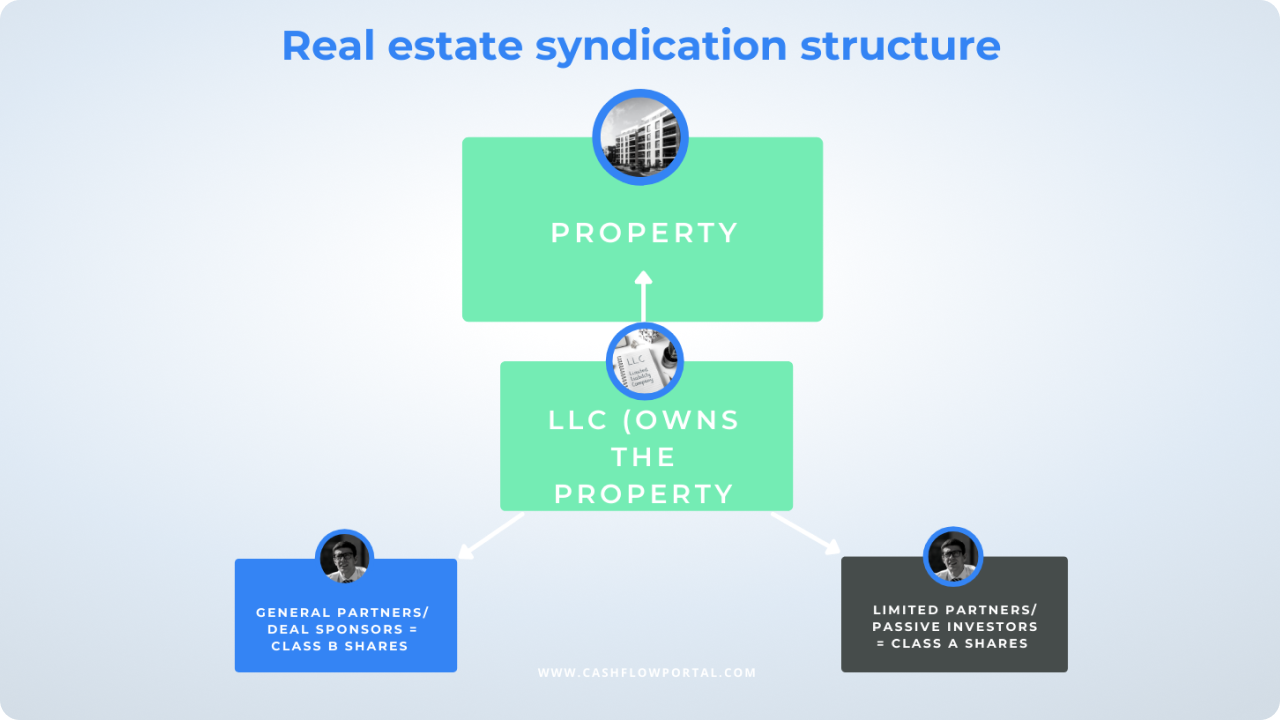
The two parties involved in a real estate syndication deal are:
- General Partners (GP) also referred to as syndicators or sponsors
- Limited Partners (LP) also known as passive investors
General partners find the deal, arrange financing, raise capital and run the property. Passive investors pool their funds to acquire the property and share in the returns.
Which role fits you? If you prefer a hands-off approach to income-producing real estate, investing as a limited partner may suit you. If your skills and network could make a deal succeed, consider becoming a sponsor; our guide on how to form your first sponsorship team is a good place to start. For a side-by-side comparison of the two roles, see GP vs LP: what is the difference?
How to structure a real estate syndication, step by step
Every syndication is structured in roughly the same order. Each decision shapes the next.
- Form the entity. Most sponsors set up a new LLC for each deal, with the sponsor’s company as managing member and investors as members. Some deals still use a limited partnership. Either way, the entity owns the property, so investors’ risk is limited to what they put in.
- Choose the SEC exemption. Syndications are securities offerings, so most rely on Regulation D. Under Rule 506(b) you can’t advertise the deal publicly, but you can accept up to 35 non-accredited investors who are financially sophisticated. Under Rule 506(c) you can market openly, but every investor must be accredited and you must verify it.
- Set the sponsor fees. Decide which fees the GP will charge (acquisition, asset management, refinance, disposition) and at what rates. See the fee table below.
- Set the profit split. Pick a structure: a straight split, a preferred return, or a full distribution waterfall. This is what investors will compare most closely across deals.
- Draft the offering documents. Your attorney prepares the private placement memorandum (PPM), the operating or partnership agreement, and the subscription agreement. These make the structure legally binding.
- Raise and close. Investors review the documents, sign, and fund. Most sponsors file a Form D with the SEC within 15 days of the first sale and file notices in the states where investors live.
Legal Structures in Real Estate Syndication
The two common legal entities used for real estate syndications are:
- A limited partnership (LP)
- A limited liability company (LLC)
In a limited partnership, the general partner runs the deal and the limited partners invest. Limited partners have no say in day-to-day management and aren’t responsible for the partnership’s debts beyond what they invested.
The general partner of a limited partnership carries unlimited liability for the partnership’s obligations. That is why sponsors rarely act as general partner in their own name: they form an LLC to serve as the GP. Many syndications skip the LP form and use an LLC for the whole deal, with the sponsor’s company as manager and investors as members. In both cases, passive investors’ liability is generally limited to the amount they invest. (verify)
Along with limited liability for its members, an LLC offers flexible taxation and relatively low operating costs.
Type of investment
The next consideration is the investment itself, in particular:
- The type of investment you are offering
- The type of investors you are working with
First, you need to know whether you are offering a security. The two federal laws that matter most are:
- The Securities Act of 1933, which governs the offering of securities by an issuer
- The Securities Exchange Act of 1934, which regulates transactions in securities
Because these rules are complex, work with a securities attorney when you structure a syndicate.
A simple test helps. Your deal is likely a security if it has all of these:
- An investment of money
- An expectation of profits from the investment
- A common enterprise
- Profits that come from the efforts of others (the sponsor)
Next, the investors you work with decide which rules apply. There are two types:
- Accredited investors, who meet SEC thresholds for income, net worth or professional qualifications
- Non-accredited investors, who don’t
The mix of investors decides which SEC exemption you can use, 506(b) or 506(c), and that in turn shapes how you can market the deal and what you must verify.
How Fees Factor into Syndications
Sponsors usually invest only a small share of the equity, so most of their pay comes from fees and from a share of the profits. These are the common fees:
| Fee | What it pays for | Charged on | Typical range | When it is paid |
|---|---|---|---|---|
| Acquisition fee | Finding, negotiating and closing the deal | Purchase price | 1–2% | At closing |
| Asset management fee | Overseeing the property manager, reporting to investors | Equity invested (sometimes gross revenue) | 1–2% a year | Monthly or quarterly |
| Refinance fee | Arranging a new loan | New loan amount | 0.25–1% | At refinance |
| Disposition fee | Preparing and managing the sale | Sale price | 0.25–0.75%, on top of the broker’s commission | At sale |
| Promote (carried interest) | The sponsor’s share of profits | Profits above the preferred return | Set by the split, e.g. 20–30% | From cash flow and sale |
We’ve covered the legal considerations for real estate syndication structures. Now, it’s time to look at the distribution of returns between sponsors and passive investors.
As a rule, limited partners get a return on the funds they contribute to a real estate deal. Deal sponsors lose out to passive investors in capital investments they make and, therefore, the returns earned. To compensate for this gap in earnings, general partners may work fees into a joint venture syndicate. Let’s look through the common fees involved in property syndication projects.
Ownership & Compensation Structure
Example: how a syndication structure pays out
The numbers below are illustrative, not from a real deal.
A sponsor buys an apartment building and raises $2,000,000 from LPs. The deal offers an 8% preferred return, then a 70/30 split (70% to LPs, 30% to the GP). It’s held for five years.
A typical year of cash flow. The property produces $200,000 available for distribution.
| Step | LPs | GP |
|---|---|---|
| 8% preferred return on $2,000,000 | $160,000 | — |
| Remaining $40,000, split 70/30 | $28,000 | $12,000 |
| Total for the year | $188,000 | $12,000 |
The sale. In year five, the property sells and $3,400,000 is left after paying off the loan and closing costs.
| Step | LPs | GP |
|---|---|---|
| Return of LPs’ original $2,000,000 | $2,000,000 | — |
| Remaining $1,400,000, split 70/30 | $980,000 | $420,000 |
| Total at sale | $2,980,000 | $420,000 |
If every year looked like the one above, LPs would receive $3,920,000 in total on their $2,000,000 ($940,000 from five years of cash flow plus $2,980,000 at sale): 1.96x their money. The GP earns $480,000 from the split ($60,000 from cash flow plus $420,000 at sale), plus any fees.
This assumes the pref was paid in full each year. When it isn’t, a cumulative pref carries the shortfall forward to be paid before any split, while a non-cumulative pref doesn’t; the operating agreement says which. To keep the example simple, it leaves out the sponsor’s own investment; in practice GPs often put in 10–20% of the equity.
Straight split
A straight split, also called a clean split, divides cash flow and sale profits by a fixed ratio between LPs and the GP. Splits range from 50/50 to 90/10 in favor of limited partners. This structure can work well for investors in high-yield deals. In some cases, a general partner may ask for a larger share to reflect the work involved.
Preferred return
With a preferred return, passive investors earn a set annual return (often 6–8%) before the general partner shares in any profit. Once the pref is paid, the remaining cash is split under the agreed structure.
Distribution waterfall
A distribution waterfall pays out in tiers, in a set order:
- Return of capital: LPs get their original investment back before the GP receives any profit share.
- Preferred return: LPs receive their set return.
- GP catch-up: the GP receives a larger share until it has caught up to its agreed percentage of profits.
- Carried interest: remaining profits are split at the agreed percentages.
For how leverage changes these returns, see Levered vs unlevered IRR.
Also, here is a video on the topic:
Real estate syndications by property types
Now, what property types can you invest in with real estate syndications to earn passive income? In fact, a variety of asset classes are eligible for real estate syndication: you can invest in commercial real estate or apartment syndication deals.
Let’s outline the common property types that qualify for syndication deals.
Multifamily and apartment syndications
Apartment buildings are the most common syndicated asset. Many are value-add deals: the sponsor buys an older property, renovates units, and raises rents. The structure usually reflects that plan. A preferred return of around 7–8% is common, followed by a split anywhere from 60/40 to 80/20 in investors’ favor. Value-add deals often pay lower distributions during renovation and more at refinance or sale, so the waterfall matters as much as the pref.
Some sponsors offer two investor classes in the same deal: one with a higher fixed pref and no upside, and one with a lower pref and a share of the profits. That lets income-focused and growth-focused investors join the same deal.

Apartment syndication in residential real estate investing covers both single-family homes and multi-family real estate. What makes residential real estate syndications attractive is the steady cash flow from rents. Along with that, apartment buildings are likely to appreciate over time which means attractive profits from the property sale.
Industrial: warehouse, logistics and distribution syndications
Industrial syndications buy warehouses, distribution and fulfillment centers, logistics facilities, and light manufacturing space. Many of these properties have a single tenant on a long lease, often triple-net (NNN), where the tenant pays most property expenses.
That changes the structure. Cash flow is steadier and more predictable than in a value-add apartment deal, so returns depend more on the lease than on the sponsor’s work. Industrial syndications therefore often have steadier distributions and a smaller promote. The biggest risks are tenant concentration (one tenant leaving can empty the building) and lease length, so check both before comparing the projected returns.
Mobile home parks

With the growing demand for affordable housing, real estate syndications in mobile home parks can be lucrative. This real estate investment type generates strong cash flow as tenants stay in parks for a long time. A mobile home park syndication can either own the park without homes or own both the park and homes in it. When the syndication owns only the land, residents own their homes and cover their upkeep, which keeps operating costs low.
Self-storage

Engaging with syndication that invests in self-storage real estate is another proven way to generate passive income. Self-storage properties provide storage facilities for individuals to store their household items as well as specialized storage facilities for cars, boats, or documents. This real estate investment option ensures good cash flow and is not labor-intensive in management.
Retail real estate
Just like with office spaces, retail real estate syndications invest in both single-tenant and multi-tenant properties. Retail real estate properties include malls, strip centers, power centers, and lifestyle centers, to name a few. The specifics of the retail property syndication subtype are the importance of traffic and parking. For example, for strip centers, vehicle traffic matters most while urban retail properties rely on foot traffic primarily.
The three phases of a real estate syndication
- Origination (acquisition and raise). The sponsor finds the property, negotiates the purchase, lines up financing, sets the structure, and raises capital from investors. This phase ends at closing.
- Operations. The sponsor runs the business plan: renovations, leasing, and day-to-day oversight of the property manager. Investors receive regular distributions and reports, and their K-1s at tax time.
- Exit (liquidation). The sponsor sells or refinances the property. Proceeds go through the waterfall: investors get their capital back, then the remaining profit is split. A refinance can return part of investors’ capital while the deal keeps running.
The structure set in phase one decides how money flows in phases two and three, which is why it’s worth understanding before you invest.
How to choose the right deal structure for you?
Now, you may be wondering: which real estate syndication structure to choose? There is no straightforward answer to this question since many factors matter:
- Syndicators’ experience and track record (find out how to choose the right syndicator here)
- The types of investors participating
- Market conditions
- Risk tolerance level
- The desired involvement in the process
- And more
With high profits from the property sale, a straight split real estate syndication structure might work best for you by providing attractive returns. This structure is also good for investment projects with a high potential to appreciate over time. For example, when investing with a self-directed IRA account, your priority is a high profit in the end rather than ongoing cash flow payouts.
If greater cash flow distributions interest you more than earnings accumulated in the long run, the preferred return structure might be a better option for your personal investing goals.
So, you need to assess each real estate syndication deal individually to make sure it aligns with your investment goals. When the motivations of general partners and limited partners coexist harmoniously, the syndicate has a greater chance of achieving the financial goals of all participants.
Running a syndication once it’s structured
The structure is only as good as how it’s run. After closing, sponsors have to track every investor’s commitment and ownership percentage, calculate the pref and the split correctly each period, send distributions, share reports, and get K-1s out on time. On a deal with dozens of investors, or across several offerings at once, spreadsheets break down quickly.
That’s what syndication software is for. A platform like Cash Flow Portal handles the work in one place:
- Capital raising: online subscriptions, e-signatures, and accreditation tracking.
- Investor management: commitments, ownership, and documents for every investor.
- Distributions: waterfall calculations and payments.
- Reporting: an investor portal with updates, statements, and K-1s.
Explore our investor portal and SPV product today!
FAQ
What is a real estate syndication? A real estate syndication is a deal where a sponsor pools money from several investors to buy a property together. The sponsor (GP) finds and runs the deal; the investors (LPs) provide most of the capital and share in the profits.
How are real estate syndication deals usually structured? Most use an LLC that owns the property, a Regulation D exemption for the raise, a set of sponsor fees, and a profit split. The split usually includes a preferred return for investors, then a share of the remaining profit for the sponsor.
What are the common fee structures in a real estate syndication? The most common are an acquisition fee (1–5% of the purchase price or capital raised, often around 2%), an annual asset management fee (1–3% of capital raised), a refinance fee (1–2% of the new loan amount) and a disposition fee (2–3% of the sale price). Sponsors also earn a promote, a share of profits above a set return. Fees vary by deal, so check the PPM and operating agreement.
What legal entity are most real estate syndications organized as? Most syndications today are organized as limited liability companies (LLCs). Limited partnerships (LPs) were the traditional structure and are still used. Both limit investors’ liability to the amount they invest.
What are the three phases of a real estate syndication? Origination (finding the deal and raising capital), operations (running the property and paying distributions), and exit (selling or refinancing and returning capital).
What roles do sponsors and passive investors play? Sponsors find the deal, arrange financing, raise capital, and manage the property. Passive investors provide capital and receive distributions but have no say in day-to-day decisions.
How does real estate syndication work for passive investors? You review the deal and its documents, sign the subscription agreement, and fund your investment. After that, you receive distributions and reports, a K-1 each tax year, and your share of the proceeds when the property sells.
How are multifamily syndications structured? Most multifamily syndications use an LLC, a 7–8% preferred return, and a split anywhere from 60/40 to 80/20 in investors’ favor. Value-add deals often pay more at refinance or sale than in the early years.
About the author

Alexandra Kazakova
Alexandra is a Community Manager at Cash Flow Portal. She writes blog posts, demos, guides and shares tips and tricks for running a successful syndication business.
Related posts

GP vs. LP in Real Estate: What’s the Difference?
By Alexandra Kazakova | 10/28/24 | Passive investor guides
If you’re new to the world of real estate investment, understanding the roles of General Partners (GPs) and Limited Partners (LPs) is crucial. Let’s break it down in a friendly and straightforward way. In a real estate syndication, the General Partner (GP) actively manages the investment, while Limited Partners (LPs) generally provide capital and participate […]

Real estate syndication risks and how to mitigate them
By Alexandra Kazakova | 12/01/22 | Passive investor guides
Real estate syndications are often not only a great investment opportunity, but also a way to diversify your wealth portfolio. The right real estate deal can be a great addition for investing purposes and in many cases can have tremendous potential for growing your money. However, there are risks associated with every business or investment, […]

Real Estate Syndication Terminology: How to Read a Deal
By Alexandra Kazakova | 10/11/22 | Passive investor guides
A real estate syndication is a group investment in which a sponsor organizes and manages a real estate investment while passive investors provide the equity capital. The sponsor—often called the general partner (GP) or managing member—is typically responsible for finding the property, arranging financing, executing the business plan and managing the investment. Passive investors, often […]
Most popular posts
 AI for Capital Raisers07/08/26 | Guides for syndicators
 Best CRM for Capital Raisers07/01/26 | Guides for syndicators
 The 10 Hottest Cities to Invest in Real Estate Before 202507/20/22 | Announcements
 Bonus Depreciation for Real Estate Professionals09/09/21 | Passive investor guides
 Free tools to help you develop your real estate syndication blog in 202108/06/21 | Guides for syndicators
Categories


 Seattle, WA









Support
Contact usProducts
Capital raising
Why Cash Flow PortalEquity raising simplifiedFunds on Cash Flow PortalCo-sponsorsCustom brandingProperty management
BookkeepingBank syncQuickbooks integrationReportsOwner portalMaintenanceApplications & eSignTenant screeningCRMRent collectionTenant portalCommunicationFund admin
Fund administrationInstitutional fund administrationSPVsFund admin servicesIntegrated CPA servicesBanking
Integrated bankingLeads
New leads©2026 All rights reserved. Cash Flow Portal Inc.